Writing is fundamentally different from other school subjects. Here's how we teach it.

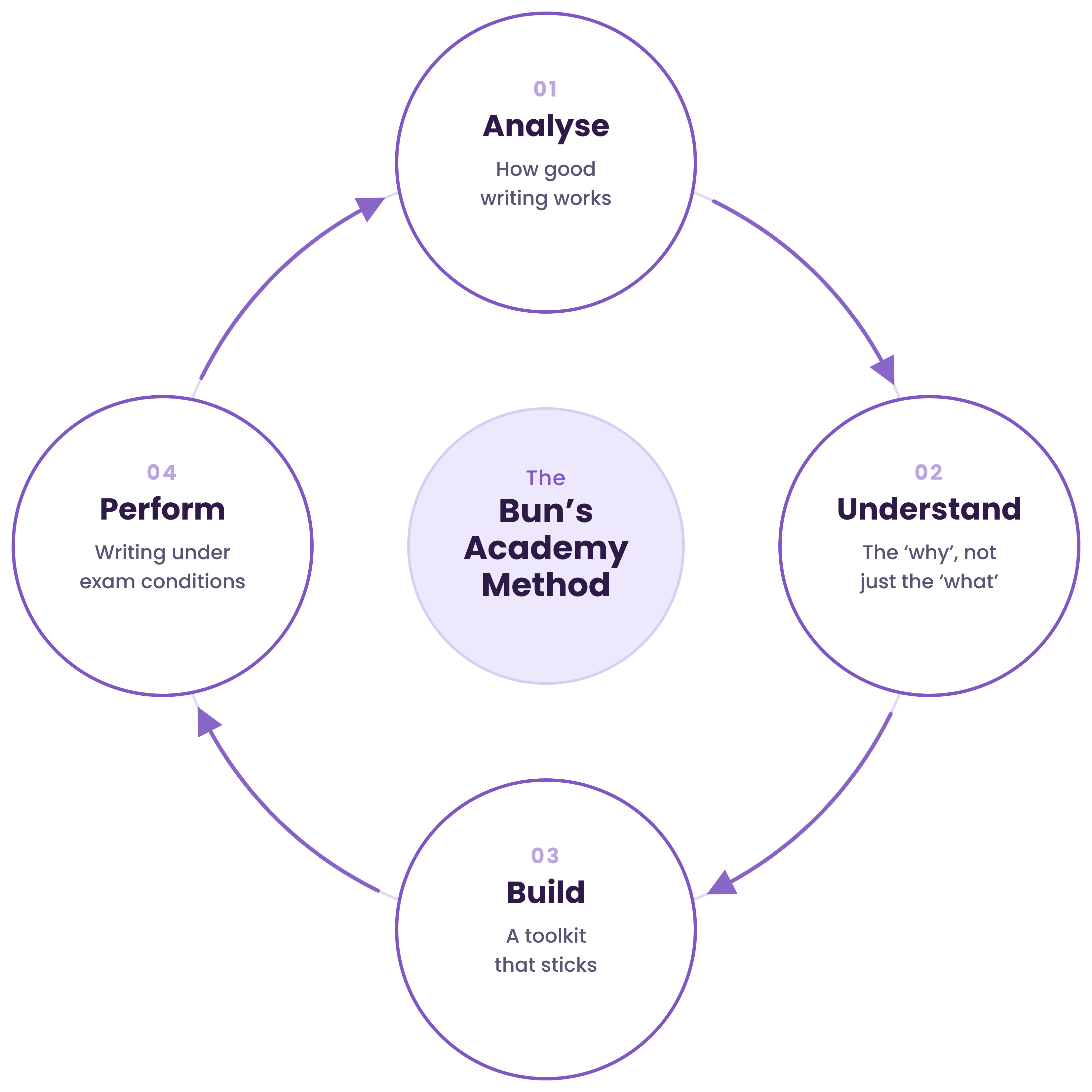
A student can't write a strong story until they can recognise one. So before they write, we study good writing together, taking a strong piece apart to see how it works.
In class, students learn to spot the choices behind good writing:
These are the same choices we then teach them to make in their own writing. A student who can see how good writing is built is ready to build it themselves.
Memorising an impressive phrase is easy, and it fails the moment the topic changes. So we teach students why a technique works, and when to use it.
A student who only copies is stuck the moment the question is unfamiliar. A student who understands can take the same tools into any topic, any exam, and know exactly what to do.
That difference, understanding over memorising, is what makes writing hold up when it counts.
Writing is a language, and a language is learned through repetition. Across the year, every student builds a real, usable toolkit:
We return to each of these again and again, across different topics throughout the year, until students use them naturally, leaning less on guidance and more on their own judgement.
A wonderful story deserves a complete ending. In an exam, writing well is only half the task. A student has to deliver a complete, well-developed piece within a fixed time, and at upper primary and secondary, across more than one kind of writing.
So we teach students to:
Through regular practice under exam conditions, finishing well becomes a habit for all our students.
Thousands of students have found their voice at Bun’s. If you’d like your child to be one of them, get in touch.